A World on Film
Stanley Kauffmann
1966
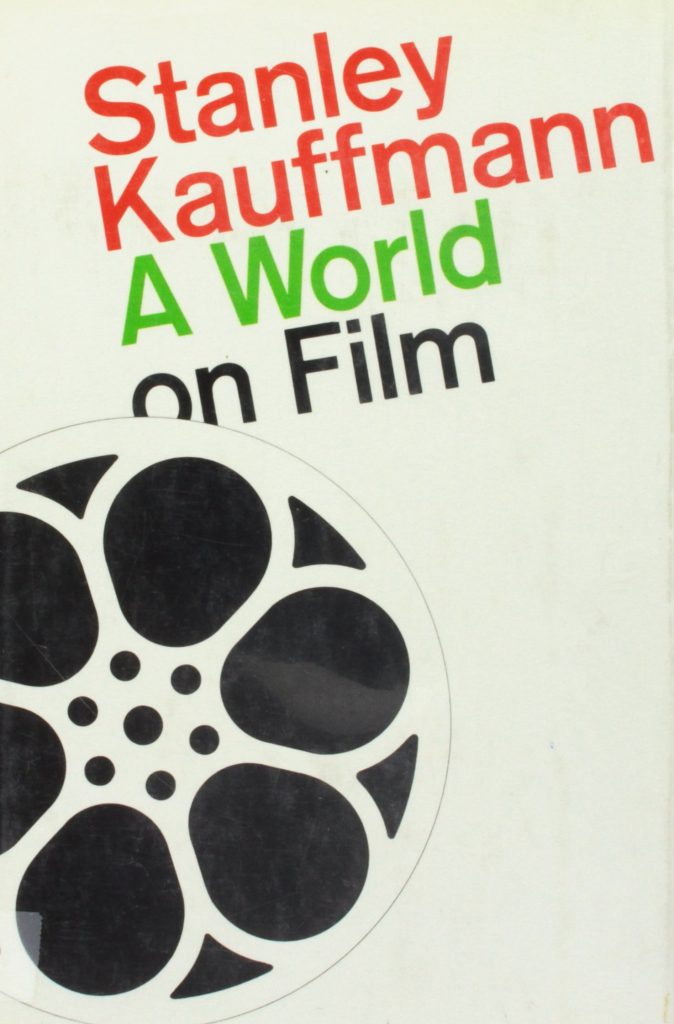
In what is (I believe) the first collection of film reviews by Stanley Kauffmann, longtime film critic for The New Republic, A World on Film offered for me a most interesting primer on world cinema at a time when I still lacked the ability to see most of these films. In that sense, this volume is an historical snapshot of when the international scene was exploding, from 1958 to 1964, when these reviews were originally written. Ostensibly, this book is divided into four parts. The first, Subjects, collects reviews that fall into categories of, respectively, War, Spectacles, Acting, and Adaptation. The second and longest part, Countries, proved the most useful to my studies. Reviews herein are divided by country of origin: United States, England, France, Sweden, Italy, Other Europeans, Some Asians (India and Japan). Part Three, Events: Political and Cinematic has various politically themed films and documentaries, plus an overview of world cinematic happenings. The fourth The Film Generation, is an eponymous essay about this new generation of cinephilia.
But back to Part Two, as I’d prefer this review to end on a crescendo. Much of the then-current scene is reflected here: the French and Italian New Waves, Kurosawa, Satyajit Ray, British Kitchen Sink, and even American Underground too, for that matter. It might be noted that even though we regard many of these films today as classics, many critics back then may have pointed out how these new emperors have no clothes. As it stands, Kaufmann offers fair arguments for, or against, some of those years’ cinematic trends. Sometimes, he can be prickly, as in his hilarious review for Agnes Varda’s Cleo from 5 to 7, with a step-by-step guide, “How Do You Know You Can’t Be A New-Wave Director?” From the time I first picked this book up I also remember his review of Antonioni’s Red Desert, which I had seen that spring. I’m not sure that he liked the film any more than I did, which isn’t saying much, but I like how he used his prose to more describe the film, perhaps as a way to figure out how he felt about it.
No critic’s word is gospel; simply put, their interpretations can hint at what (not) to expect. Imperfect art is still integral to the changing faces of history. As it stands, this book was very important to my burgeoning interest in world cinema; this whet my appetite for the many more films I had yet to track down. I first read this book from a library copy. (Back in the day, my hometown had a whopping two collections of film reviews – Pauline Kael’s When The Lights Go Down was the other.) I would eventually find my own at that long gone used bookstore on Queen West, next to the also long gone used record store, Driftwood Music.