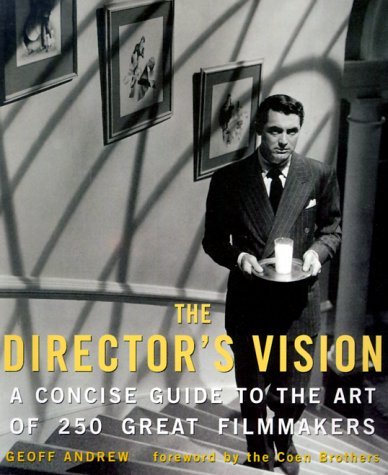
The Director’s Vision: A Concise Guide to the Art of 250 Great Filmmakers
Geoff Andrew
1999; ACappalla Press
Here is an interesting coffee-table book with unusual subtext: take 250 famous directors, devote only one still (and one page of text) for each, and discuss how this singular image is representative of their work as a whole. Of course, a project like this must be accepted on its own terms- a) you must believe that the director is the sole auteur of such a collaborative thing as film (and the choices within firmly accentuate that point- which is why Samuel Fuller is in here and Joel Schumacher is not); b) because it is sometimes so hard to find the proper stills to accentuate one’s point, one must make do with others that kinda sorta work (any movie zine publisher would know that liability).
More often than not, Mr. Andrew is right on the money- for Bresson, he chooses a closeup of two hands in Au Hasard, Balthazar, suggesting the director’s consistently impersonal world; for Samuel Fuller, it is a still from the opening of The Naked Kiss where the hairless prostitute beats up her john, thus summarizing its creators’ delight in outrageousness and deliverance in the manner of a tabloid headline. Anthony Mann is wrapped up with The Naked Spur, positioning James Stewart against a mountain (Mann’s favourite motif for man’s degeneration to savagery).
Other times, you long for other representative ideas. For Robert Altman, he chooses a scene from The Long Goodbye, clashing private eye Elliott Gould with hippie nudists. The traffic jam sequence in Nashville would probably have better exemplified the director’s busy, eclectic world. Then there are times in which you question the inclusion of someone- Michael Cimino? Okay, we’ve got a still of The Deerhunter, and we begin to think of Cimino’s fall from grace, until Andrew cleverly relates this one image to the director’s whole oeuvre being excessive in dramatic and production set-pieces (never more so than in his expensive flop, Heaven’s Gate).
Some will carp over who made the cut in the 250 chosen here. Even Ed Wood is in the book with a still from Glen or Glenda (and you’ll see why he chose that particular one!). Balk though you will, Wood’s films are instantly recognizable, thereby passing one-half of this book’s criteria.
The Director’s Vision is a wonderful (though a bit pricey) gift for that film lover in your family. The illustrations are eye-popping in their richness, and this is much more than a coffee table book. Each startling image is accompanied with a crisp, compact profile on one’s lifetime of work. You will be impressed.