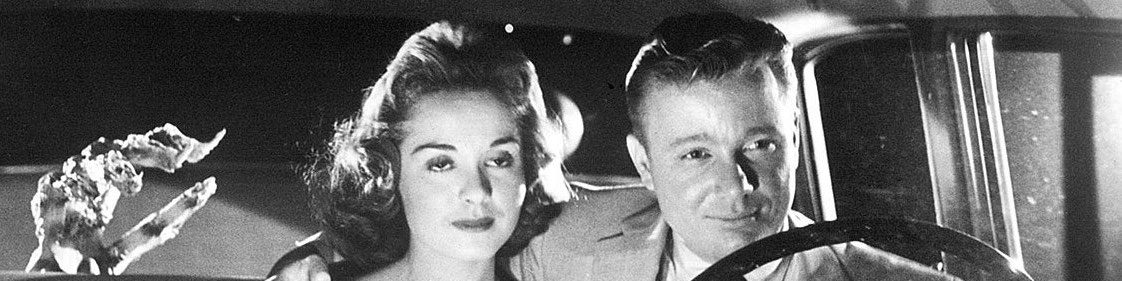
Hot Tomorrows (USA, 1977) 71 min B&W DIR-PROD-SCR: Martin Brest. DP: Jacques Haitkin. CHOR: Lloyd Gordon. CAST: Ken Lerner, Ray Sharkey, Hervé Villechaize, Victor Argo, George Memmoli, Donne Daniels, Rose Marshall, Sondra Lowell, Orson Welles (voice). (AFI)
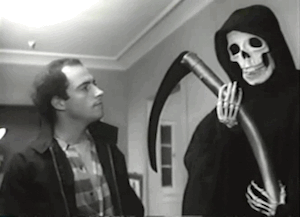
“We’re watching the movie with two dead people. That’s what’s so great about old movies- you’re entering the land of the dead.”
This is a typically moribund statement uttered by the death-obsessed author Michael (Ken Lerner), much to the consternation of his fellow Bronx-native friend Louis (Ray Sharkey), who has journeyed to Los Angeles to visit his old pal for some good times. The line above, by the way, is uttered while the two men watch Laurel and Hardy in a funny scene from The Bohemian Girl. This scene is indicative of the entire film: moments of supposed joy are subtly coloured with dread. And once good-time-seeking Louis and the bleak Michael go out for some action on Christmas Eve, we realize that this isn’t going to a typical holiday movie fare.
In his book Movie Wars, author Jonathan Rosenbaum makes the snarky assertion that the only good thing the American Film Institute ever did was finance David Lynch’s first feature, Eraserhead. Well, no. Hot Tomorrows, the first feature by Martin Brest (later of such hits as Beverly Hills Cop and Scent of a Woman), was also produced via the AFI, yet it’s unfortunate that this $38,000 wonder has never received its deserved audience. Today, this black comedy is sought by collectors, especially for the appearance of Danny Elfman and the Mystic Knights of the Oingo Boingo, who are the musicians in the sparsely populated Paradise Ballroom, one of the stops of our protagonists’ fateful journey on December 24.
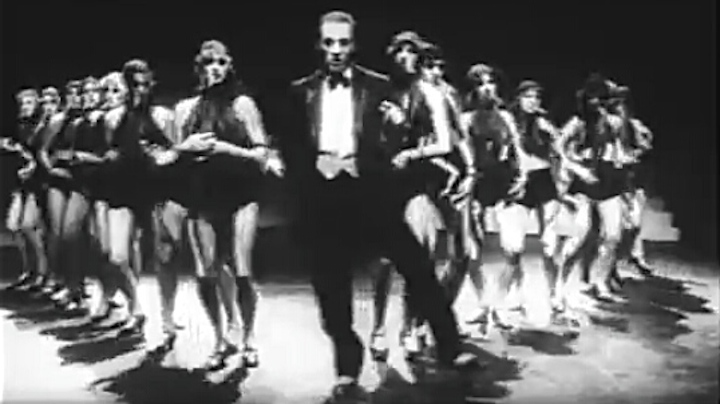
Shot in glistening black and white by Jacques Haitkin, these flickering images recall the spirit of the old movies that the men refer to, especially in the bizarre 42nd street revue that closes the film. The deeply expressionist photography indeed captures the moribund atmosphere that surrounds Michael (in fact the hard key lighting on the band suggests a cabaret act from beyond the grave), but it also enhances the sorrow and loneliness that permeates the lives of our principal cast.
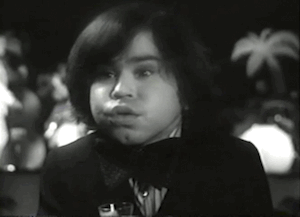
Even without the death-obsessed symbolism, Hot Tomorrows is a valuable film for its alternative look at Christmas-time. It beautifully captures the holiday season for those who find this time of year difficult, as they are shiftless, alone, and looking for something (anything) to do. All of these displaced people find their ways to the Paradise Ballroom (tellingly, the only clientele on Christmas Eve), and find momentary companionship with one another. Michael and Louis befriend another Bronx native, Tony (Victor Argo), who accompanies his rich, socially awkward friend and employer Albrecht (Hervé Villechaize!), while the latter’s wife carries out an “arrangement” with her boyfriend. In addition, Louis chats up a girl, Polly (Sondra Lowell), whom one senses yearns for greater things, but doesn’t know what or where. This sequence is a moving portrait of people trapped in their own limited lives.
And if this scene isn’t a desperate enough way to spend Christmas Eve! Upon leaving the club, the two men hear a radio ad (voice by Orson Welles!) about a funeral home offering free coffee to sober people up and prevent car accidents (“it’s better to drive here than to be carried here”). This is all the provocation that Michael needs. What follows is another scene of displaced people who have momentarily converged in their pursuits of something to do while alone on December 24. However, Michael manages to cajole the funeral director into seeing the embalming equipment, and in a moment that climaxes his death fantasies, he views the corpse of an old woman. Michael has been working on a story about his aunt Ethel, who appears as the “face of death”, seen in photos, posing at the supermarket, and even in the funeral home.
Although Hot Tomorrows sometimes plods in its short running time, it is a jewel of a movie- at once a black comedy about death and a moving portrait of urban loneliness, which results in tragedy, yet concludes with a bizarre sequence that is equally moribund and (somehow) life-affirming. As of this writing, it has never been released to video, so see this film however you can! It would make a perfect double bill with 1984’s Nothing Lasts Forever, another black and white gem that was unreleased, and also could’ve been a monster cult hit.